

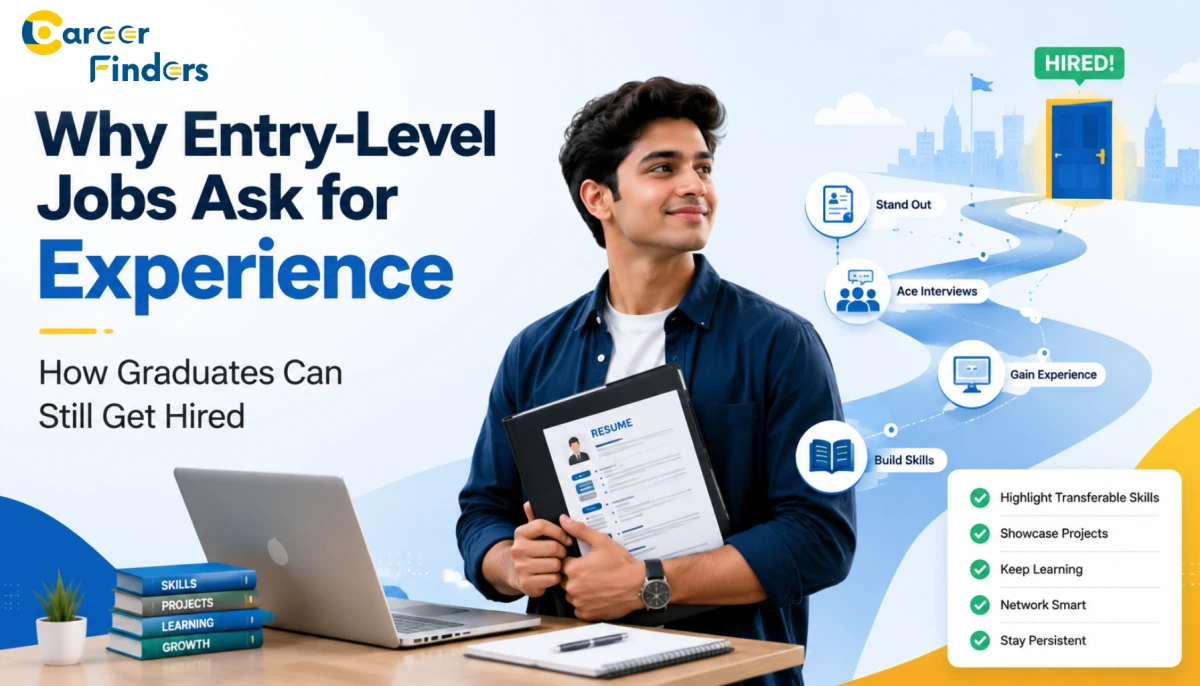
Starting your career should feel exciting. But for many graduates and first-time jobseekers, searching for an entry-level role can quickly become frustrating.
You find a job labelled “Entry Level”, open the description, and then see something like:
“1–2 years of relevant experience preferred.”
It immediately raises a question: If the job is entry level, why do employers expect experience?
The good news is that experience does not always mean years spent in a full-time professional job. Employers are often looking for evidence that you can communicate, solve problems, work with others and apply what you have learned.
Understanding what employers actually mean by “experience” can help you apply with more confidence and build a stronger job application.
Companies want to reduce hiring risk.
Recruiting and training a new employee takes time and money. Employers therefore look for candidates who already understand some workplace basics and may require less initial supervision.
That does not necessarily mean they expect you to have previously performed the exact same job.
When an employer asks for experience, they may actually be looking for evidence that you can:
You may already have demonstrated several of these abilities without holding a traditional full-time role.
This is one of the biggest mistakes new jobseekers make.
A job advertisement may say:
“1–2 years of experience preferred.”
The important word here is preferred.
Employers often describe their ideal candidate in job advertisements. They may still interview someone who does not meet every requirement but demonstrates strong potential.
For example, imagine an employer wants someone with:
You may not have one year of professional experience, but perhaps you have the qualification, Excel skills, communication ability and relevant university projects.
You could still be a competitive applicant.
Avoid rejecting yourself before the employer has even reviewed your application.
Students often underestimate their academic projects.
A major assignment can involve many of the same skills required in a workplace.
For example, suppose you completed a university project where your team analysed customer behaviour and presented recommendations.
Instead of simply writing:
University marketing project
you could explain the work professionally:
Customer Behaviour Analysis Project
You are not pretending it was employment.
You are simply showing the employer what you actually did and which transferable skills you developed.
A retail, hospitality, warehouse or customer service job may look unrelated to your future career.
But it can demonstrate valuable workplace skills.
Imagine you are applying for an entry-level HR position after working in a café.
Your café experience may have taught you:
Those skills matter in HR too.
Instead of focusing only on the industry you worked in, identify the transferable skills from that experience.
A graduate with strong workplace behaviour and communication skills can sometimes be more attractive than someone with technical knowledge but little evidence of teamwork or responsibility.
Internships are one of the clearest ways to bridge the gap between education and employment.
Even a short internship can give you exposure to:
Volunteering can also demonstrate relevant skills.
For example, helping a community organisation manage social media could support an application for a junior marketing role.
Managing registrations at an event could demonstrate administration and customer service skills.
Helping a club maintain financial records could support an accounting or finance application.
The key is explaining what you actually contributed, rather than simply listing the organisation.
Personal projects are particularly useful for candidates entering technology, marketing, design, data and creative careers.
A software graduate could build a website or mobile application.
A marketing graduate could create a sample social media campaign.
A data candidate could analyse a public dataset and build a dashboard.
A graphic designer could develop a portfolio containing branding concepts.
A finance graduate could create an Excel-based financial model.
Projects show employers something valuable:
You can turn knowledge into practical work.
They can be especially useful when you have limited formal employment experience.
Sending exactly the same resume to 30 different employers may feel efficient, but it often reduces your chances of getting shortlisted.
Different employers prioritise different skills.
Before applying, compare the job description with your resume.
Identify the main requirements and ask yourself:
Where have I already demonstrated these skills?
Suppose the advertisement repeatedly mentions:
“Customer communication, reporting, Excel and attention to detail.”
Those capabilities should be easy to find in your resume.
You could demonstrate them through:
Your resume should make the connection obvious rather than expecting the recruiter to figure it out.
Many resumes contain sections like:
Skills:
Communication, teamwork, leadership, problem solving, time management.
There is nothing necessarily wrong with listing skills, but employers see similar lists constantly.
Evidence is stronger.
Instead of simply claiming you have teamwork skills, show where you used them.
For example:
“Worked in a five-person university team to research competitor pricing and present recommendations within a four-week deadline.”
Now the employer can see both teamwork and time management in a real situation.
The same principle applies during interviews.
Whenever possible, support your answers with examples.
Job searching and skill building do not have to happen separately.
While applying for positions, continue creating evidence of your abilities.
You could:
For example, if several jobs you want require Excel, spending a few weeks improving Excel and completing a practical project can strengthen future applications.
The goal is not to collect endless certificates.
Choose skills that repeatedly appear in the jobs you actually want.
Job descriptions describe an employer's preferred candidate, not necessarily the only candidate they will consider.
You should still use judgement.
If a role requires a professional licence, security clearance or mandatory technical qualification you do not have, that requirement may genuinely prevent you from being considered.
But being slightly below a preferred experience level is different.
If you meet most of the important requirements and can demonstrate relevant abilities, applying may still be worthwhile.
Let the employer decide whether your experience is sufficient.
Do not automatically make that decision for them.
Experienced professionals can point to years of previous results.
Graduates usually cannot.
That means your application needs to communicate something different: potential.
Employers hiring entry-level workers understand that candidates are still developing professionally.
They may therefore pay close attention to your:
A candidate who understands the company, explains their experience clearly and shows genuine interest can stand out even without years of employment history.
Seeing experience requirements on entry-level jobs can be discouraging, but “experience” is broader than full-time employment.
Your university projects, internships, volunteering, casual work, personal projects and extracurricular activities may already contain valuable evidence of your ability.
The challenge is presenting that experience in a way that makes sense to an employer.
Instead of thinking:
“I don't have experience.”
Ask:
“What evidence do I have that I can perform the skills this employer needs?”
That small change in approach can completely change the way you build your resume, prepare for interviews and evaluate job opportunities.
Your first employer does not need you to know everything.
They need enough evidence to believe that you can learn, contribute and grow into the role.