

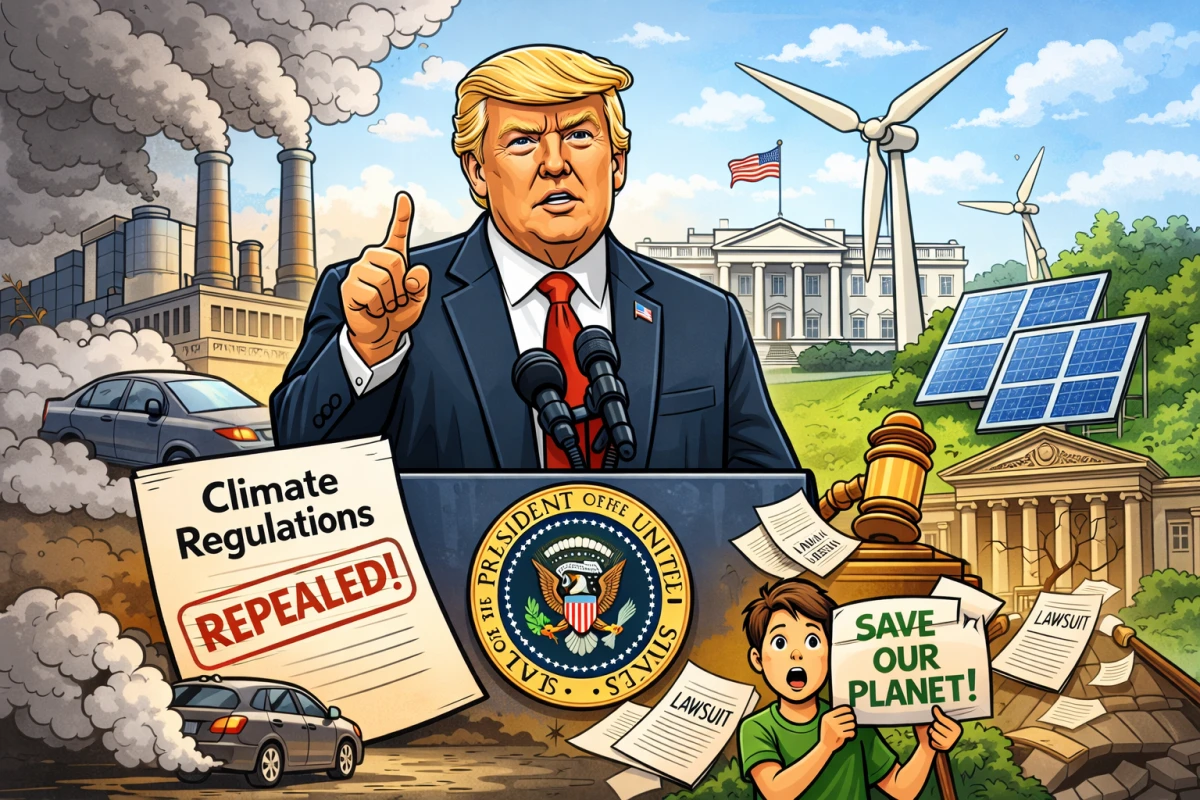
The recent decision by Donald Trump to revoke the scientific basis of US climate regulation has sparked global debate. The move, implemented through the Environmental Protection Agency, removes the long-standing framework used to regulate vehicle greenhouse gas emissions under the Clean Air Act.
While the political implications dominate headlines, the real story for employers, students, and jobseekers lies in the economic ripple effects.

The EPA has withdrawn the 2009 “endangerment finding,” which previously allowed the federal government to regulate carbon emissions from vehicles. As a result:
• Federal vehicle emission standards are being rolled back
• Compliance requirements for automakers are reduced
• Regulatory costs for manufacturers may decrease
This signals a shift in US industrial and environmental policy that could influence hiring patterns across multiple sectors.
Reduced compliance costs may lead to increased production activity in traditional fuel vehicle manufacturing. Employers in automotive engineering, supply chain management, logistics, and mechanical design could see short-term growth.
However, global markets still demand EV and green technology innovation. Companies operating internationally must balance deregulation in the US with stricter standards in Europe and Asia.
Fossil fuel and traditional energy companies may expand operations due to regulatory easing. This could increase demand for:
• Petroleum engineers
• Project managers
• Industrial safety specialists
• Energy infrastructure technicians
At the same time, renewable energy firms may adjust hiring strategies depending on federal incentives and policy direction.
Interestingly, regulatory shifts often create new demand for legal experts, policy analysts, and sustainability advisors who help companies navigate uncertainty.
Policy change does not eliminate compliance complexity. It reshapes it.
Students planning careers in:
• Environmental science
• Automotive engineering
• Renewable energy
• Industrial technology
• Public policy
must understand that global climate trends continue despite domestic policy shifts.
International employers still prioritize sustainability credentials. Green skills remain highly valuable in global markets.
The key is adaptability. Employers increasingly value candidates who understand both regulatory landscapes and market shifts.
Policy changes like this create both opportunity and volatility. Employers adjust hiring strategies. Industries pivot. New roles emerge while others decline.
For jobseekers and students, staying informed about global economic and regulatory trends provides a competitive edge.
Platforms like CareerFinders.co help connect candidates with evolving industry opportunities across automotive, engineering, energy, compliance, and sustainability sectors.
Whether you are an employer tracking market shifts or a student preparing for future industries, understanding global policy changes is now part of smart career strategy.
source
Associated Press (AP News)
https://apnews.com/article/c149d5ea6ec71c862e6c4b578adf92cd
The Guardian
https://www.theguardian.com/us-news/2026/feb/12/trump-epa-rollback-pollution-regulation-endangerment-finding
The Hindu (Original Article You Shared)
https://www.thehindu.com/news/international/trump-revokes-basis-of-us-climate-regulation-ends-vehicle-emission-standards/article70625830.ece
#ClimatePolicy #USJobs #AutomotiveIndustry #EnergySector #CareerPlanning #GlobalHiring #EnvironmentalCareers #JobMarket2026