

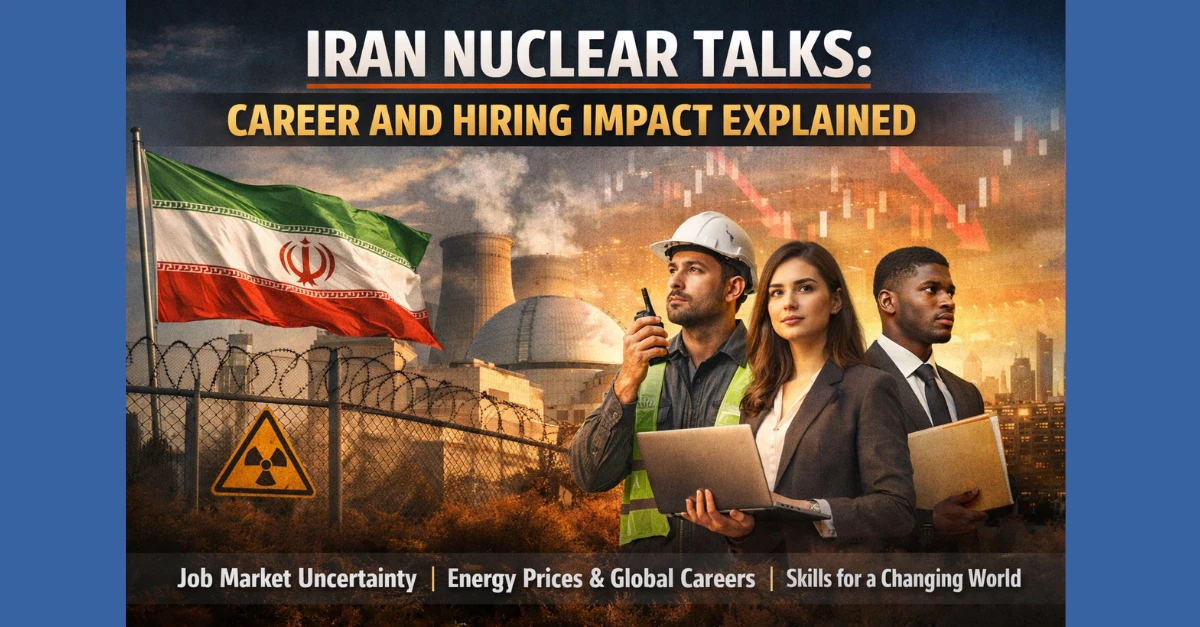
Iran’s decision to continue its uranium enrichment programme despite negotiations in Oman has created renewed geopolitical uncertainty. While the issue appears political and strategic, its consequences extend far beyond diplomacy. Employers, students, and global job seekers should closely monitor how these developments influence hiring markets, international trade, and workforce demand.
Geopolitical tensions often influence supply chains, energy prices, and investor confidence. When uncertainty rises, many companies slow expansion plans and become more selective in hiring. Businesses operating in logistics, manufacturing, aviation, energy, and global trade sectors may face operational cost increases, which can temporarily impact recruitment budgets.
However, geopolitical shifts also create opportunities. Companies investing in alternative supply chains, defence technology, cybersecurity, and energy diversification often increase hiring to strengthen resilience. Employers planning long-term growth should monitor global policy developments and adjust workforce strategies accordingly.

Students and early-career professionals frequently underestimate how global politics influences job availability. When global uncertainty rises:
Energy, defence, technology, and cybersecurity sectors often see stronger hiring demand
International trade disruptions can increase demand for supply chain professionals
Multinational companies expand regional hiring hubs to reduce geopolitical risk
For students planning international careers, focusing on globally transferable skills such as data analytics, logistics, engineering, international business, and digital technology can significantly improve employment resilience during uncertain global conditions.
Despite short-term geopolitical tensions, long-term workforce demand continues to grow globally due to digital transformation, infrastructure expansion, and demographic workforce shortages across developed economies. Countries like Australia, Canada, and several European nations continue expanding skilled migration pathways to address workforce gaps, ensuring that international career opportunities remain strong.
For employers and candidates alike, the key is adaptability. Economic shifts may change hiring patterns temporarily, but global talent demand continues to rise in technology, healthcare, engineering, and skilled trades.
Global geopolitical developments are not just political headlines. They directly influence hiring strategies, workforce demand, and international career mobility. Employers who track these shifts make smarter workforce decisions, while students who build globally relevant skills remain competitive regardless of economic cycles.
India Today – Iran refuses to give up uranium enrichment programme
Reuters – Iran insists on right to enrichment in Oman talks
Iran says US must accept domestic enrichment (Iran International)
Reuters – Iran threatens response if US attacks