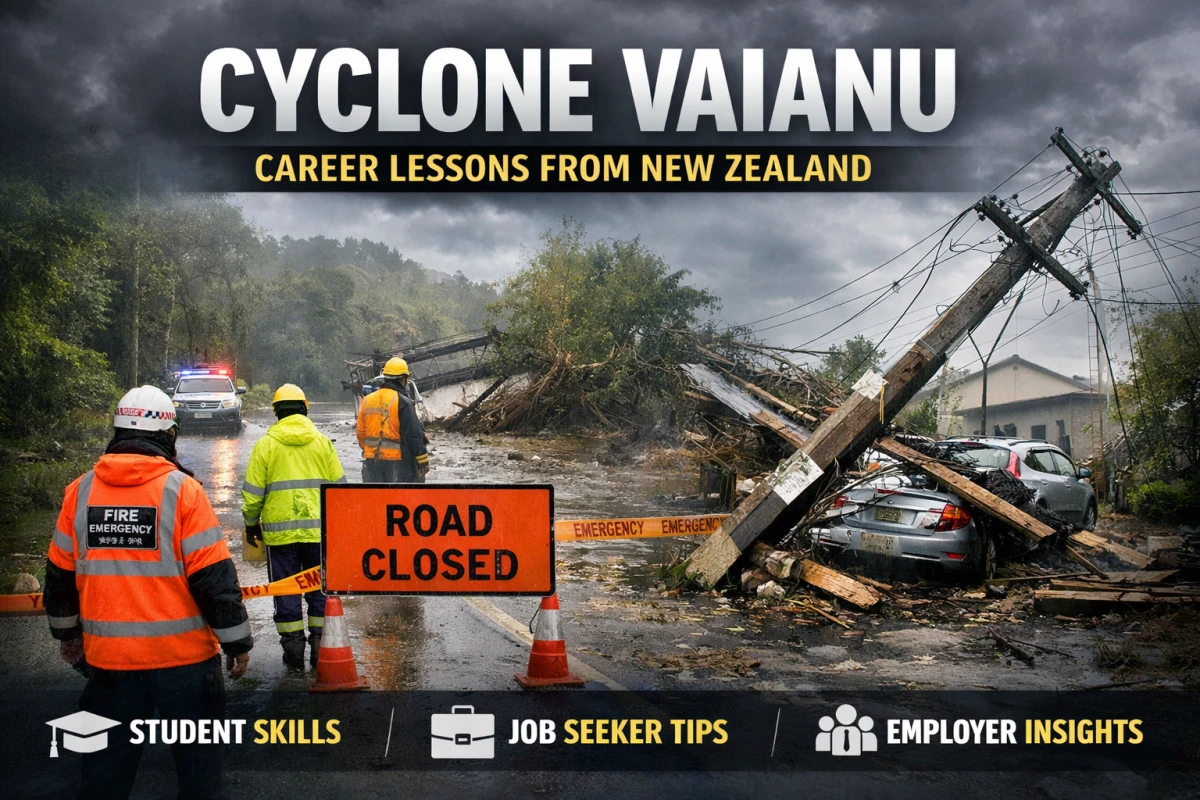
Cyclone Vaianu brought major concern across parts of New Zealand, especially in Hawke’s Bay, where severe weather conditions created power outages, road blockages, evacuations, and safety warnings. Reports showed that one of the strongest gusts reached 194km/h, while some areas recorded 253mm of rain over 48 hours. Even with those serious conditions, Hawke’s Bay avoided the kind of widespread destruction many people had feared. Authorities later lifted weather warnings, and evacuees were allowed to return home after emergency teams assessed the situation.
At first glance, this may look like a weather story only. But for students, job seekers, employers, and working professionals, it also reflects something much bigger: how preparation, teamwork, communication, and calm decision-making can reduce damage during real-life crises. Officials said the region had “come through the cyclone relatively well,” and New Zealand’s Emergency Management Minister said the country had “dodged a bullet,” adding that preparation helped reduce the impact.
That is exactly why this story is relevant for a careers and employment platform like CareerFinders.co. In today’s world, employers are not only hiring for technical ability. They are also looking for people who can stay calm under pressure, adapt to change, communicate clearly, and respond responsibly when unexpected situations arise.

Cyclone Vaianu is a reminder that no workplace, industry, or career path is completely free from disruption. Natural disasters, sudden market shifts, technology changes, supply chain issues, and business interruptions can affect anyone. In Hawke’s Bay, more than 500 homes were told to evacuate, roads were temporarily closed, and hundreds of homes were left without power as crews worked to restore services.
What helped reduce larger damage was not panic. It was planning, response systems, field coordination, and people doing their jobs properly. That same principle applies to careers.
For students, this means academic knowledge alone is not enough. Employers increasingly value practical qualities like reliability, teamwork, situational awareness, and problem-solving.
For job seekers, this story shows why interview questions about handling pressure, solving problems, or working in uncertain situations are so important. Companies want people who can respond with maturity and focus.
For employers, the cyclone highlights the value of workforce planning, business continuity, crisis communication, and employee safety systems.
Students often think career success starts after graduation. In reality, it starts much earlier through habits and mindset.
Emergency teams and local authorities were able to respond because systems were already in place before conditions got worse. The same is true in careers. Students who prepare early by building skills, improving communication, and gaining experience are in a much stronger position when opportunities come.
Preparation in career terms can include:
Success usually does not come from last-minute effort. It comes from being ready before the pressure arrives.
Cyclone events force communities and services to adapt quickly. Roads close, plans change, and teams must respond based on current conditions. In the same way, students entering modern workplaces must be flexible. Industries evolve fast, job roles change, and employers value people who can learn quickly instead of resisting change.
During disruption, emotional reactions can make things worse. Clear thinking helps people act effectively. Students who learn to stay calm during exams, deadlines, presentations, and setbacks often perform better in professional environments too.
Job seekers can take several strong career lessons from this event.
Resilience does not just mean “working hard.” It means being able to handle setbacks, uncertainty, delays, and change without losing direction. In many industries, especially customer service, logistics, healthcare, education, operations, and management, this is a major advantage.
The Hawke’s Bay response included updates from civil defence, utility providers, road authorities, and government officials. Power restoration teams, councils, and emergency personnel all had roles to play.
In a job setting, clear communication can be the difference between confusion and action. Job seekers who can explain themselves well, listen properly, and share updates clearly often stand out more than candidates who only list qualifications.
Many resumes say “excellent problem-solving skills,” but employers want proof. Use examples from real life, studies, volunteering, internships, or previous jobs to show how you handled pressure, uncertainty, or unexpected issues. That is what makes your profile stronger.
For employers, the Cyclone Vaianu story is also a business and workforce lesson.
The article notes that preparation helped reduce the cyclone’s impact and that teams were already assigned to known damage sites while also patrolling for further issues. This is a strong reminder that organisations need clear response plans, internal communication channels, and employees who know what to do when conditions change.
When severe events happen, leaders are judged by how well they protect people, communicate decisions, and support recovery. Good employers build trust by putting employee wellbeing ahead of short-term productivity.
Anyone can lead when everything is stable. Real leadership appears during uncertainty. Employers should invest in managers and teams who can make practical decisions, communicate calmly, and support staff during disruptions.
Cyclone Vaianu was serious, but Hawke’s Bay avoided the worst. That happened because of preparation, response, and coordinated action. The same principle applies in education, job searching, and business.
Students need to prepare before opportunity arrives.
Job seekers need to build resilience and communication skills.
Employers need to create systems, train teams, and lead responsibly.
In a changing world, career success is no longer based only on marks, degrees, or years of experience. It is also based on how well people and organisations respond when situations become uncertain.
That is why stories like this matter beyond the headlines. They show the kind of mindset that helps people grow, stay employable, and lead effectively in real life.
Whether you are a student planning your future, a job seeker looking for better opportunities, or an employer building a stronger workforce, Cyclone Vaianu offers an important reminder: preparation, adaptability, and teamwork are not optional anymore — they are essential career strengths.
At CareerFinders.co, these are exactly the qualities that help people succeed in modern workplaces.