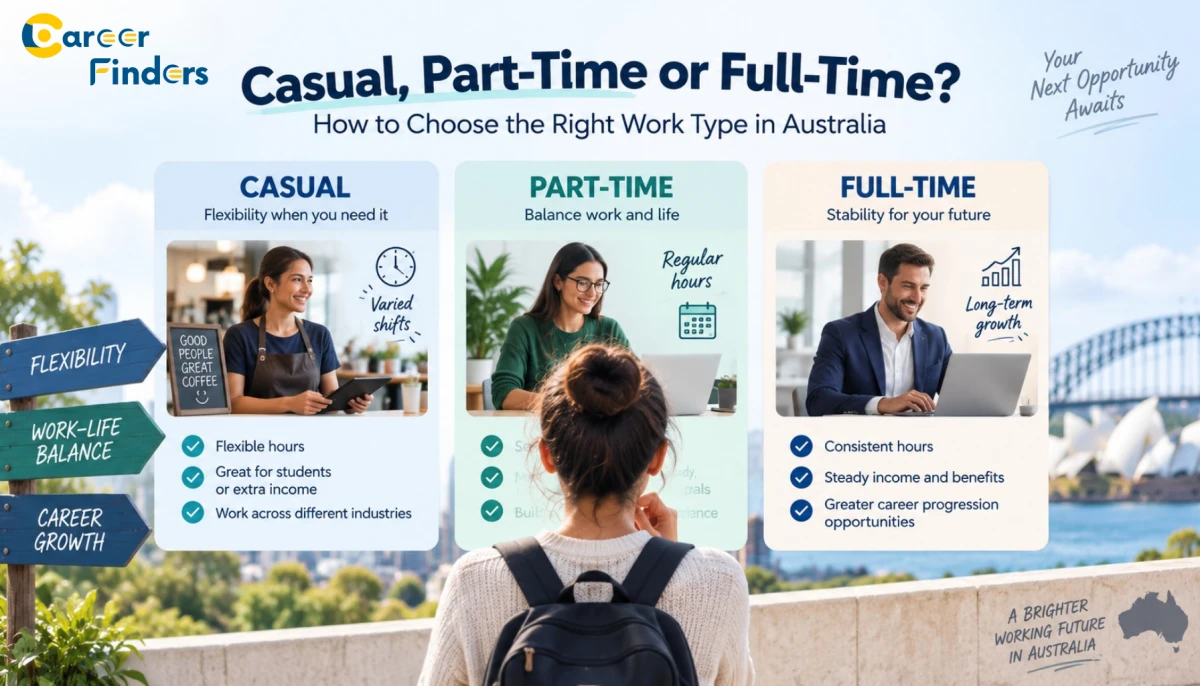
Finding the right job is not only about choosing an industry, company or salary. The type of employment you accept can also make a major difference to your working hours, income, flexibility, leave arrangements and long-term career plans.
When searching for jobs in Australia, you may regularly see positions advertised as casual, part-time or full-time. For someone entering the workforce for the first time, studying while working, returning after a career break or changing industries, understanding these options can sometimes be confusing.
One type of employment is not automatically better than another. The right choice depends on your current situation, financial needs, availability and career goals.
Before applying for your next position, it is worth understanding how each employment type generally works and what you should consider before accepting an offer.
What Is Full-Time Employment?
Full-time employment is often suitable for people who want regular employment, consistent working hours and greater long-term stability.
According to the Fair Work Ombudsman, full-time employees generally work an average of 38 ordinary hours per week, although actual hours can vary depending on the occupation, award, enterprise agreement or employment arrangement.
Full-time employment may be permanent or offered through a fixed-term arrangement.
Full-time employees generally receive minimum employment entitlements under the National Employment Standards, including applicable paid leave.
For many job seekers, full-time work can be attractive because it may provide:
Regular weekly hours
More predictable income
Paid annual leave
Paid personal or carer’s leave
Greater continuity in the workplace
More opportunities to take responsibility
Stronger long-term career development
However, full-time work also requires a larger weekly time commitment.
Before accepting a full-time role, consider whether the expected hours, travel time, roster and responsibilities fit comfortably into your life.
What Is Part-Time Employment?
Part-time work can provide a useful balance between regular employment and additional flexibility.
Fair Work describes part-time employees as generally working fewer than 38 hours per week, with hours that are usually regular. Part-time employees generally receive the same minimum entitlements as full-time workers on a proportional basis, including applicable annual and personal leave.
Part-time work can be particularly useful for:
Students
Parents and carers
People completing professional training
Workers returning after a career break
People managing another job or business
Professionals who prefer fewer working hours
For example, a student may work three regular days each week while attending university on the remaining days.
This can provide workplace experience and regular income without requiring the same weekly hours as a full-time position.
Part-time employment should not automatically be viewed as less valuable for your career. A relevant part-time position can help you build industry knowledge, professional references and practical skills.
What Is Casual Employment?
Casual employment is common across industries such as hospitality, retail, warehousing, events, administration and customer service.
Under current Fair Work rules, casual employment involves specific legal criteria, including whether there is a firm advance commitment to ongoing work and whether the worker is entitled to a casual loading or specific casual rate.
Casual work can offer greater flexibility because available shifts may vary.
For some job seekers, that can be a major advantage.
A university student, for example, may prefer casual work because their availability changes between study periods. Someone returning to the workforce may also use casual employment to rebuild recent experience.
Casual employees generally receive a casual loading or specific casual rate, but they do not receive most forms of paid leave available to permanent employees.
This is why job seekers should compare more than the hourly rate when evaluating a casual opportunity.
Consider the complete employment arrangement.
Think About Stability Versus Flexibility
One of the biggest questions when choosing an employment type is whether you currently value stability or flexibility more.
A person with regular financial commitments may prefer predictable hours and income.
Another person may need flexibility because they are studying, caring for family members or managing other responsibilities.
Ask yourself:
Do I need guaranteed or regular working hours?
Can I manage if my weekly hours change?
Do I need flexibility to manage study or other commitments?
Would paid leave be important to me?
Am I looking for a temporary opportunity or a longer-term position?
There is no single correct answer.
The important thing is choosing an employment arrangement that realistically fits your circumstances.
Consider Your Career Goals, Not Just Your Current Schedule
Your employment type can also influence your career development.
Suppose your long-term goal is to become a restaurant manager.
A casual hospitality job may initially help you gain experience, understand restaurant operations and develop customer-service skills.
Later, you may decide that a permanent position provides better opportunities to take responsibility, supervise employees or progress towards management.
Similarly, a student studying accounting might start with a part-time administration role. Even if the job is not their final career destination, they can develop workplace communication, software, reporting and organisational skills.
Think about what the position can help you build.
Ask:
What will I learn?
Will this experience strengthen my resume?
Does the position provide skills relevant to my future career?
Could there be opportunities to progress?
The employment type matters, but the quality and relevance of the experience matter as well.
Compare the Complete Job Offer
A higher hourly rate does not always mean a job is automatically the better option.
When comparing two opportunities, look at the complete employment package.
Consider:
Expected weekly hours
Hourly rate or salary
Employment type
Work location
Travel expenses
Roster arrangements
Weekend or evening requirements
Applicable allowances
Leave arrangements
Training opportunities
Career progression
Workplace flexibility
For example, one casual role may offer a higher hourly rate but fewer or less predictable shifts.
Another permanent part-time role may provide regular hours and paid leave.
Which option is better depends on what matters most to you.
Avoid making the decision based on one number alone.
Read the Job Advertisement Carefully Before Applying
Job seekers sometimes apply based only on the title and salary.
Before submitting your application, read the full advertisement.
Look for information about:
Employment status: Casual, part-time, full-time or fixed-term.
Working hours: How many hours are expected?
Roster: Are weekends, evenings or public holidays required?
Location: Is the workplace practical for you?
Responsibilities: Can you perform the main duties?
Experience: Which requirements are essential and which are preferred?
Availability: Does the employer require particular days or shifts?
If important information is missing, you can ask about it during the recruitment process.
Understanding the position before accepting it can prevent problems later.
Can Casual Employment Become Permanent?
Casual work does not necessarily mean someone must remain casual permanently.
Current Australian workplace rules include an employee choice pathway under which eligible casual employees may be able to notify their employer that they want to change to permanent full-time or part-time employment. Casual employees and employers can also agree to change the employment arrangement at other times.
The rules and eligibility requirements can depend on individual circumstances, so employees should check current Fair Work information when considering a change.
From a career perspective, this means a casual opportunity can sometimes become the beginning of a longer employment relationship.
Your performance matters.
Reliability, communication, punctuality, willingness to learn and consistently good work can help you build a positive professional reputation regardless of whether you initially joined casually, part-time or full-time.
Which Employment Type Is Best for Students and Graduates?
There is no requirement for graduates to immediately find a full-time professional job in order to begin building a career.
Casual and part-time positions can provide valuable experience while you search for opportunities related to your qualification.
A retail position might strengthen:
Customer communication
Sales ability
Problem-solving
Teamwork
A hospitality role might demonstrate:
Time management
Working under pressure
Customer service
Reliability
An administration role might develop:
Email communication
Data entry
Scheduling
Microsoft Office skills
These abilities can later support applications for graduate and entry-level professional roles.
Do not underestimate experience simply because it was casual or part-time.
Employers are interested in what you learned and what you were responsible for.
Ask the Right Questions Before Accepting a Job
Receiving a job offer can be exciting, but you should still understand the employment arrangement before accepting.
Useful questions can include:
What employment type will I be hired under?
How many hours should I normally expect each week?
Will my working days be regular or rostered?
What are the usual start and finish times?
Which award or agreement applies, if relevant?
Are weekend or evening shifts expected?
What training will be provided?
Is there potential for additional responsibilities or career progression?
Asking reasonable questions does not make you difficult.
It helps both you and the employer understand whether the arrangement is suitable.
Final Thoughts
Casual, part-time and full-time employment can all provide valuable opportunities.
The best choice depends on where you are in your career and what you need from your next job.
If you want regular hours and longer-term stability, full-time employment may suit your goals.
If you need regular work with fewer weekly hours, part-time employment may provide a useful balance.
If flexibility is particularly important, casual employment may be worth considering.
Most importantly, do not judge an opportunity only by its employment label.
Look at the hours, pay structure, responsibilities, workplace, learning opportunities and long-term value of the position.
A job that suits your current circumstances while helping you develop useful skills can become an important step towards your next career goal.
CareerFinders helps job seekers explore employment opportunities and career information across Australia and New Zealand, making it easier to search with greater direction and understand the options available in a changing employment market.
There is no single best option. It depends on your need for flexibility, regular income, working hours and long-term career goals.
Yes. Part-time work can provide regular income and experience while leaving more time for study and other commitments.
Yes, if the role gives you useful experience and skills. Casual work can sometimes lead to permanent opportunities later.
Full-time employees generally work an average of around 38 ordinary hours per week, depending on their employment arrangement.
Part-time employees generally receive applicable leave entitlements on a proportional basis according to the hours they work.
Casual workers may receive casual loading or a specific casual rate because they generally do not receive some paid leave entitlements available to permanent employees.
No. Casual work can demonstrate valuable skills such as customer service, teamwork, reliability and time management.
In some situations, eligible casual employees may be able to move into permanent part-time or full-time employment under current workplace rules.
Check the employment type, expected hours, pay, roster, workplace location, responsibilities, leave arrangements and opportunities for career growth.