

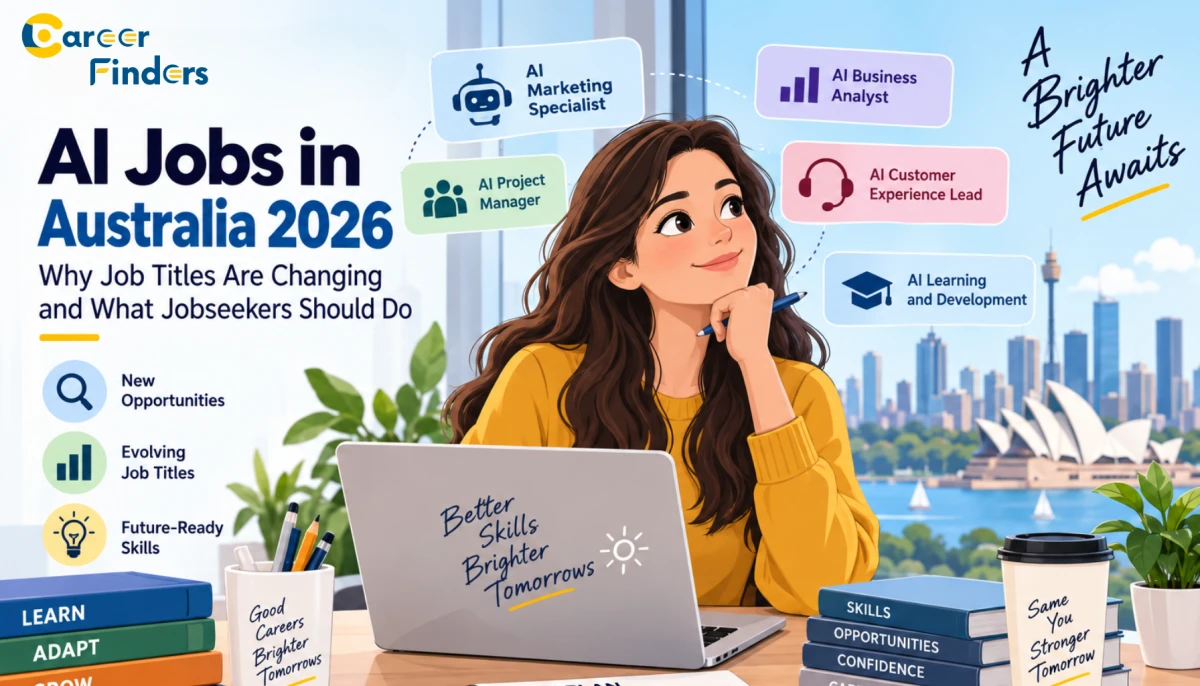
Searching for a job in Australia is starting to look different.
You may open a job board and see familiar positions described with unfamiliar titles. A marketing role may suddenly mention AI. A management position may include artificial intelligence in its title or responsibilities. Sales, education, data, customer service and operational roles are also beginning to use new technology-focused language.
This does not necessarily mean that every worker now needs to become a programmer or artificial intelligence specialist.
Instead, it shows how quickly the Australian workplace is changing.
Recent research from Indeed Hiring Lab found that the number of Australian job titles mentioning AI has more than tripled over the past year. In the March quarter of 2026, 71 normalised Australian job titles had enough advertisements mentioning AI to be classified as “AI-touched”.
For jobseekers, understanding this change can make it easier to recognise opportunities, search for jobs effectively and prepare for new employer expectations.
Job titles have always changed as industries develop.
Positions that were common ten or twenty years ago may now have different names because the technology, tools and responsibilities involved have changed.
Artificial intelligence is creating another shift.
Employers are not only recruiting people whose main job is to develop AI technology. Some businesses are also adding AI responsibilities to existing positions.
Indeed's Australian research found that although technology roles still dominate AI-related job titles, the trend is gradually spreading beyond technology. In the March quarter of 2026, 39% of AI-touched job titles were in non-tech occupations.
This means a familiar career may continue to exist while the language employers use to describe it changes.
For jobseekers, that makes understanding the actual responsibilities of a position more important than simply recognising its title.
Imagine you have worked in marketing for several years.
You understand campaigns, content, customers, reporting and digital platforms. You then find a vacancy with a title that includes terms such as AI, automation or generative AI.
It may initially appear to be a completely different career.
But when you read the job description, many of the core responsibilities may still match your experience.
The employer might simply expect candidates to use new tools for research, content analysis, reporting, administration or workflow improvement.
Indeed's research notes that many roles receiving AI-related titles are jobs that have existed for years. In some cases, employers are adding AI language because the technology has become part of the role rather than because an entirely new profession has been created.
So do not automatically reject a vacancy because its title sounds unfamiliar.
Read further first.
Jobseekers often search according to exact job titles.
That approach can now cause you to miss relevant opportunities.
Instead of asking only, “Have I held this exact job title before?”, ask whether you have performed similar responsibilities.
Look carefully at what the employer actually wants the person to do.
Consider the required skills, software, industry knowledge, communication responsibilities, reporting duties and level of experience.
For example, an employer may advertise a position using newer AI terminology while still requiring traditional skills such as problem-solving, communication, project management, stakeholder management or customer understanding.
The title attracts attention, but the responsibilities tell you whether you are genuinely suitable.
One of the biggest mistakes jobseekers can make is assuming that AI skills always mean advanced technical knowledge.
Some positions will certainly require programming, machine learning, data science or specialist technical expertise.
Many others may simply expect employees to understand how to use AI tools appropriately within their normal work.
Jobs and Skills Australia has found that generative AI is more likely to augment work rather than simply replace jobs, while digital and AI capability is becoming increasingly important across the workforce.
For a non-technical employee, useful AI capability could mean knowing when an AI tool is appropriate, checking its output, protecting confidential information and combining technology with professional judgement.
That is very different from building an AI system yourself.
As titles become more varied, job searching should become more flexible.
If you only search one exact title, you may see only part of the available market.
Suppose you are looking for digital marketing work. Searching only “Digital Marketing Specialist” may exclude positions using terms connected with automation, AI marketing, growth, content technology or digital optimisation.
The same issue can affect people working in administration, recruitment, finance, education, sales and other professions.
Search using your main skills as well as your preferred job title.
You can then compare the responsibilities and determine whether the position matches your background.
This approach is particularly useful when employers are experimenting with new language for existing types of work.
Seeing AI mentioned everywhere can tempt candidates to add the word repeatedly to their resume.
That is unlikely to help if you cannot explain what you actually did.
Instead, describe genuine examples.
If you use AI tools to research information, organise ideas, analyse data, create initial drafts, automate repetitive work or improve a workflow, explain the practical outcome.
For example, saying that you “used AI” provides very little information.
Explaining that you used an AI-assisted workflow to reduce the time required for a repetitive reporting task gives the employer more context.
Your resume should still focus on results, responsibilities and evidence.
Technology is a tool. Employers ultimately need to understand what you can achieve with it.
The rise of AI does not mean traditional workplace skills have stopped mattering.
In fact, new technology can make judgement, communication and accountability even more important.
An AI system may help generate information quickly, but an employee may still need to decide whether that information is accurate, appropriate and useful.
A tool can assist with a draft, but a person remains responsible for understanding the audience and business objective.
A system may analyse information, but employees still need to explain the result to colleagues, customers or management.
Jobs and Skills Australia has highlighted both digital capability and non-digital capabilities as important as workplaces adapt to generative AI.
Therefore, do not remove communication, teamwork, critical thinking or problem-solving from your career story simply because technology is receiving more attention.
If AI appears in a job advertisement, there is a reasonable chance the employer will want to understand your experience with it.
You do not need to pretend to know every platform.
A clear answer about one or two genuine examples is usually more useful than naming many tools without explaining how you used them.
Think about a real work, study or project situation.
What problem were you trying to solve? Which tool did you use? What part of the process did it assist with? How did you check the output? What was the final result?
This demonstrates both technology awareness and professional judgement.
It also helps employers understand whether you can use new tools responsibly rather than simply following the latest trend.
New job titles can sound exciting.
However, candidates should still evaluate positions in the same careful way they would evaluate any other vacancy.
Check the responsibilities, experience requirements, employment type, salary information where available, location and expected outcomes.
Ask yourself whether the position offers work that actually matches your skills and career direction.
An AI-related title does not automatically make a job more advanced or more suitable for your future.
The substance of the role matters more than the terminology.
Australian hiring activity has not stopped while workplaces adapt to new technology.
Jobs and Skills Australia's August 2026 employer survey found that 50% of surveyed employers had recruitment activity, while 20% expected to increase staffing levels. At the same time, 45% reported recruitment difficulty.
That combination shows why skills remain important.
Employers are recruiting, but many are also trying to find candidates who match changing requirements.
Jobseekers do not need to chase every new trend. However, understanding which tools and skills are becoming relevant to your particular occupation can help you stay competitive.
Small, continuous learning is often more practical than waiting until your industry has already changed dramatically.
Artificial intelligence is not only creating new jobs in Australia. It is also changing the language used to describe existing work.
For jobseekers, that means career searching in 2026 requires a slightly broader approach.
Do not rely only on familiar job titles. Read the responsibilities, search using skills, understand how technology is affecting your occupation and be prepared to demonstrate practical examples of how you work with new tools.
At the same time, do not allow AI terminology to make you underestimate the value of the experience you already have.
A job may have a new title while still requiring many of the same core professional skills.
The Australian job market will continue to evolve. Candidates who can understand changing job language, continue learning and clearly communicate the value they bring will be better prepared to identify opportunities as they appear.
1. Indeed Hiring Lab Australia – Old Jobs, New Buzzword: Job Titles Get an AI Makeover
Australian employers are increasingly adding AI terminology to job titles across tech and non-tech roles.
https://hiringlab.indeed.com/au/blog/2026/09/03/old-jobs-new-buzzword-job-titles-get-an-ai-makeover/
2. Jobs and Skills Australia – Australia’s AI Transition: Jobs, Skills and the Future of Work
Explains how generative AI is expected to reshape Australian jobs and mainly augment rather than simply replace human work.
https://www.jobsandskills.gov.au/studies/generative-artificial-intelligence-capacity-study
3. Jobs and Skills Australia – Our Gen AI Transition: Skills
Covers the growing importance of digital, AI and non-digital skills in Australia's workforce.
https://www.jobsandskills.gov.au/studies/generative-artificial-intelligence-capacity-study/our-gen-ai-transition-skills
4. Jobs and Skills Australia – Our Gen AI Transition: Exposure
Explains how AI may augment or automate different tasks across Australian occupations.
https://www.jobsandskills.gov.au/studies/generative-artificial-intelligence-capacity-study/our-gen-ai-transition-exposure
5. Jobs and Skills Australia – Our Gen AI Transition: Labour Market Dynamism
Provides information about AI-related upskilling, reskilling, job mobility and changing occupations.
https://www.jobsandskills.gov.au/studies/generative-artificial-intelligence-capacity-study/our-gen-ai-transition-labour-market-dynamism
6. Jobs and Skills Australia – Recruitment Experiences and Outlook Survey
Provides current Australian employer recruitment activity, recruitment difficulty and staffing outlook data.
https://www.jobsandskills.gov.au/data/recruitment-experiences-and-outlook-survey
#AIJobsAustralia #FutureOfWork #AustralianJobs #JobSearchAustralia #CareerTips #AISkills #JobMarket2026 #CareerDevelopment #AustralianCareers #WorkplaceTrends #JobSeekers #CareerGrowth #HiringTrends #DigitalSkills #CareerFinders